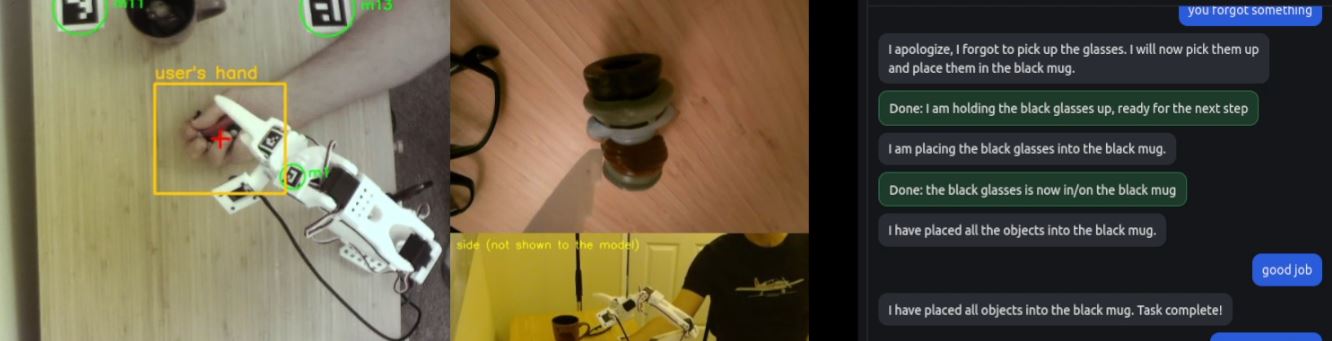
Exploring multimodal reasoning, visual perception and parameterized robotic behaviors with an SO-101 robot arm.
What happens when a general-purpose frontier LLM is given control of a physical robot? Can it interpret its environment, understand human intent, formulate a plan and manipulate objects without task-specific model training?
In previous experiments, I trained my SO-101 Robot Arm using Hugging Face’s LeRobot framework, with limited success. These included ACT, SmolVLA and π₀ (Pi0). I also experimented with Gemini Robotics ER-2 in simulation.
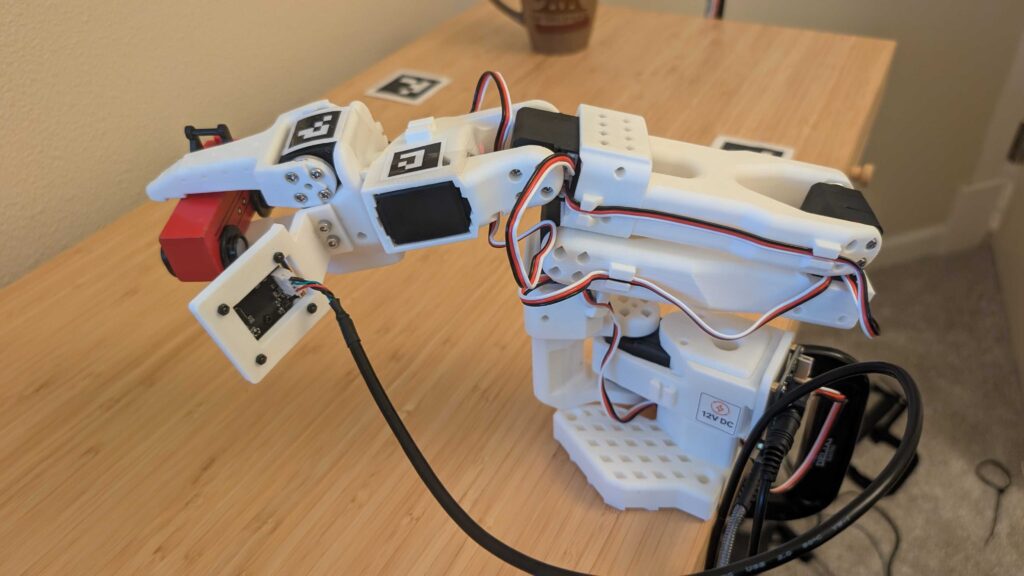
I wanted to try giving a frontier multimodal model (Fable 5.2) direct access to a robot’s cameras, motor controls and positional data, allowing it to develop its own manipulation strategies.
It was rather shocking to calibrate the SO-101 arms, connect all the cameras, then watch the robot come to life! I gave it a lengthy prompt explaining the environment and asked it to put a toy into the cup on my desk. Fable 5.2 slowly moved the robot as it interpreted its surroundings, experimented with grasping strategies, recognized failures and adapted its approach. Once it made some rough estimations of the camera extrinsics and perspectives, it moved the arm around enough to develop a working understanding of the robot’s kinematics through observation and experimentation. I’m sure that the popularity of the SO-101, along with a huge repository of publicly available code aided in the process.
As you can imagine, the process is far from realtime. Fable takes stills of the scene from all cameras, processes the image, thinks, then sends a move command to the arm. It was all extremely slow, BUT it executed the task flawlessly on the first try.
This led me to explore a different research question: At what level of abstraction should a general-purpose AI model interact with a physical robot?
The experimental platform
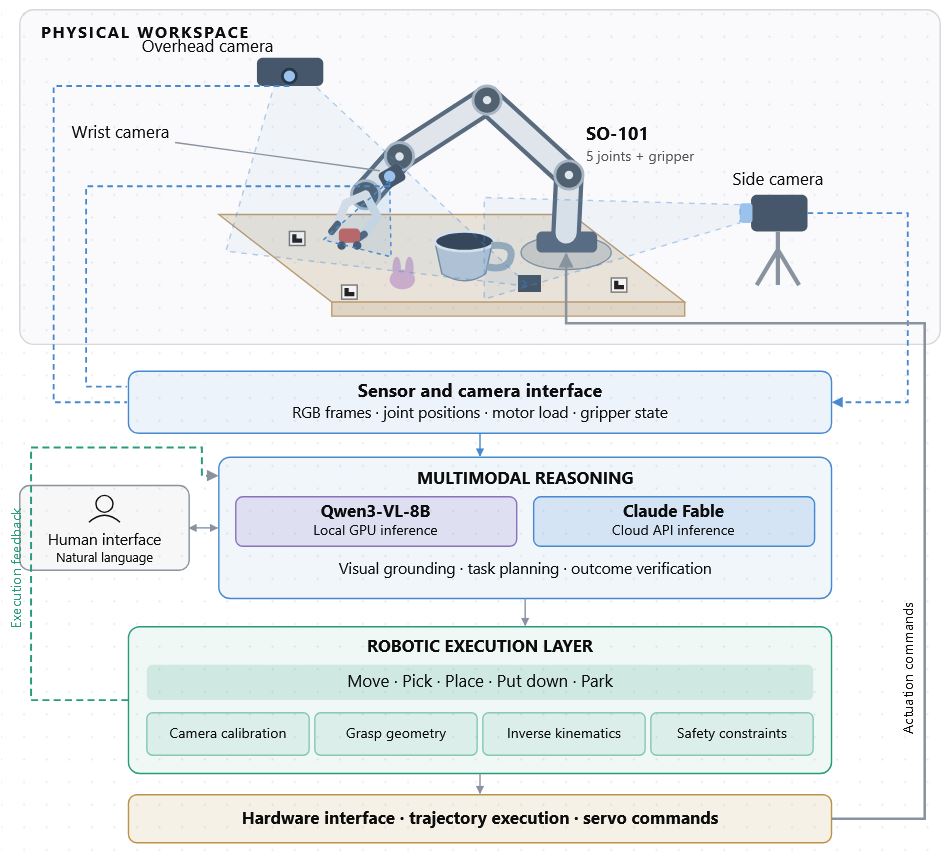
My experimental platform consisted of an SO-101 follower arm equipped with three cameras, a custom robotic control stack and two interchangeable multimodal models:
- Qwen3-VL-8B: A local vision-language model, quantized to 4-bit and running on a 16 GB GPU.
- Claude Fable 5.2: A cloud-hosted frontier multimodal model.
The overhead camera provides workspace perception, the wrist camera provides close-range visual feedback, and the side camera provides additional information about object heights and gripper positions.
Three approaches to robotic control
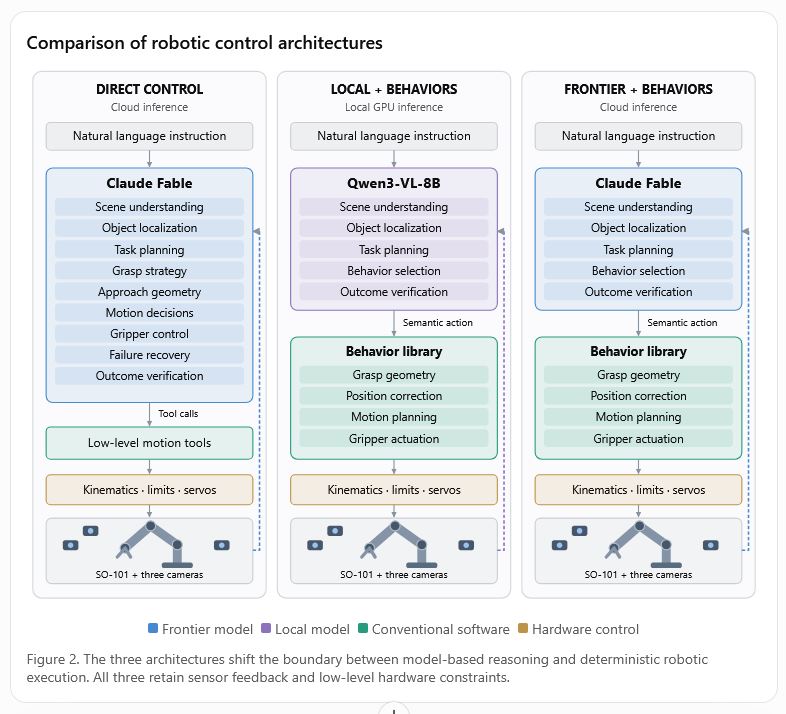
I explored three architectures that differed primarily in how responsibilities were distributed between the AI model and conventional robotic software.
Direct frontier-model control
In the initial architecture, Fable was given access to eight low-level robotic tools, including camera observation, joint control, Cartesian positioning, gripper operation and motor feedback.
The model was responsible for developing its own grasping strategies, generating motion commands and evaluating their outcomes. Although basic kinematics and safety constraints remained in software, much of the manipulation process was governed by the model.
This provided considerable flexibility but required numerous inference cycles to accomplish relatively simple physical tasks.
Local model with parameterized behaviors
I subsequently developed a library of reusable robotic behaviors, shifting responsibility for grasp geometry, motion planning and physical execution into conventional software.
Rather than generating individual motor commands, the local model could issue a semantic instruction:
{
  "do": "move",
  "object": "red toy car",
  "target": "white mug",
  "grasp": "rigid"
}
Frontier model with parameterized behaviors
Finally, I substituted Fable for Qwen3_VL while retaining the same robotic execution layer.
Fable demonstrated more consistent object recognition, stronger spatial reasoning and more efficient task planning. The combination of frontier intelligence and engineered robotic behaviors produced the strongest experimental results.
Compensating for mechanical inaccuracies
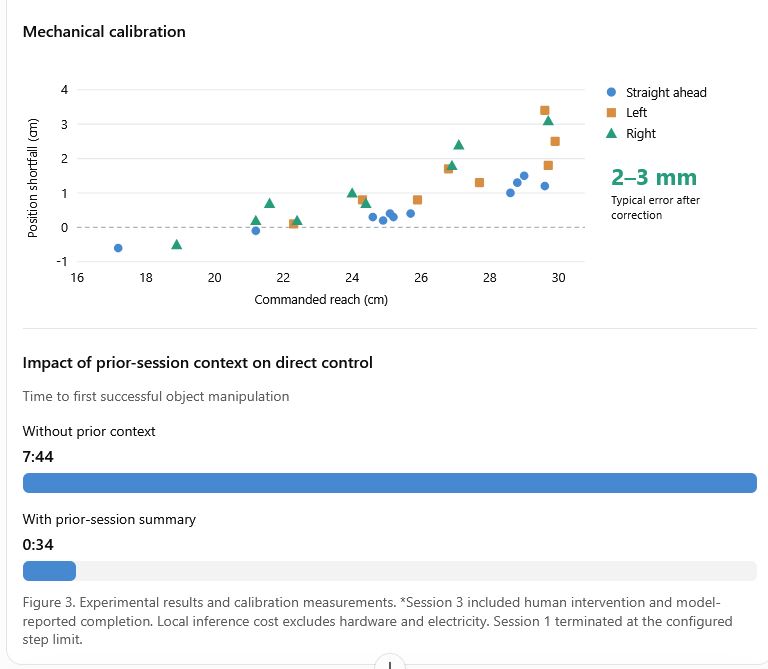
At extended reach, the SO-101 exhibited positional errors of up to 3.4 cm, varying with direction, reach and gripper orientation.
Using a printed calibration board, wrist-mounted camera and 57 physical touch measurements, I developed an empirical correction map that reduced typical positional error to approximately 2–3 mm.
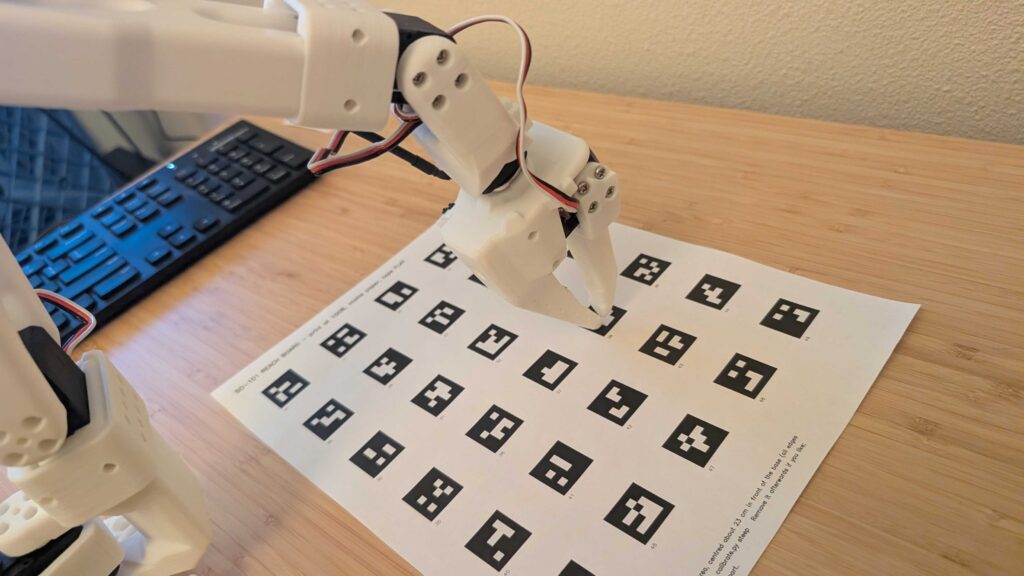
This illustrates an important distinction between the architectures. In the hybrid system, mechanical knowledge is encoded into reusable software. In direct control, the model must compensate for much of this error through repeated observation and corrective movement.
The behavior library effectively encapsulates accumulated engineering knowledge, making it accessible to either multimodal model without modifying its weights.
Experimental results
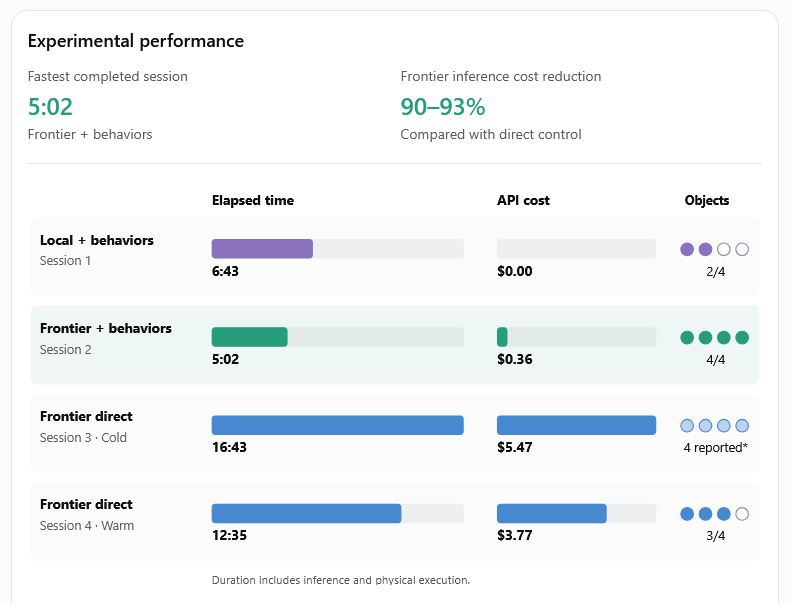
I recorded four sessions in which the robot was instructed to place four objects — a toy car, a plush bunny, a toy figure and a small black box — into a mug.
The objective was to compare the architectures in terms of execution efficiency, reasoning capabilities, task completion and computational cost.
Session 1 — Local model with behaviors
Qwen3-VL successfully managed human interaction, object recognition, planning and behavior orchestration entirely on local hardware. However, it frequently decomposed tasks inefficiently, inconsistently identified objects and required repeated manipulation attempts.
It reached the configured 12-step limit after placing two of the four objects. Some failures were attributable to the execution layer’s handling of objects between separate pick and place operations.
Session 2 — Frontier model with behaviors
Fable accurately identified the objects and recognized that the task could be accomplished using four move operations. All four succeeded without retries.
The task was completed in 5 minutes and 2 seconds at an estimated inference cost of $0.36.
Compared with the direct-control sessions, this represented approximately 2.5–3.3 times shorter execution duration and a 90–93% reduction in API cost.
Session 3 — Direct frontier-model control
Without the behavior library, Fable demonstrated an impressive capacity to reason through unfamiliar physical problems.
It recognized discrepancies between calculated and actual robot positions, experimented with grasping strategies and adapted its approach. When the toy car bounced out of the mug, it attempted to insert it end-first.
However, this process required 151 tool calls and nearly 17 minutes, illustrating the computational overhead of reasoning at a low level of robotic control.
Session 4 — Direct control with experiential memory
For the final session, I provided Fable with a short textual summary of what it had learned during the previous session.
The time required to manipulate the first object decreased from 7 minutes and 44 seconds to 34 seconds. Overall execution time decreased by approximately 25%, although three objects were confirmed rather than four.
This suggests that persistent experiential memory may offer another mechanism for improving robotic performance without task-specific model training.
What I learned
The abstraction layer is critical
The most significant performance improvement came not from changing the model, but from changing the interface through which the model interacted with the robot.
Encapsulating mechanical knowledge and manipulation strategies into parameterized behaviors allowed the model to concentrate on perception, reasoning and task-level planning rather than individual physical movements.
Local models are viable robotic orchestrators
A relatively small vision-language model running on consumer hardware can provide meaningful robotic intelligence when supported by a reliable execution layer.
The local model’s limitations were most apparent in contextual reasoning, planning efficiency and consistent object identification. For well-bounded tasks, however, local inference may provide an attractive balance between capability, privacy and computational cost.
Frontier models offer flexibility beyond predefined behaviors
Although direct control was inefficient, Fable demonstrated the ability to develop manipulation strategies that had not been explicitly programmed.
This capability may be particularly valuable when existing robotic behaviors are insufficient or when a robot encounters unfamiliar physical conditions.
Adaptation does not necessarily require model training
These experiments highlight three complementary mechanisms for improving robotic performance:
- Model training: Modifying neural-network weights through demonstrations or other training data.
- Behavior refinement: Encoding physical knowledge into reusable, parameterized robotic skills.
- Experiential memory: Preserving observations and successful strategies as context for future reasoning.
Future architectures could combine all three.
Next steps
I am particularly interested in exploring a hierarchical architecture in which local models manage routine perception and behavior orchestration while frontier models are invoked for novel tasks, complex reasoning and failure recovery.
A more ambitious objective would be to investigate whether a frontier model could use direct robotic control to discover new manipulation strategies and subsequently translate those strategies into reusable robotic behaviors.
Before drawing stronger conclusions, I intend to repeat these experiments with standardized object positions, consistent prompts, independent outcome verification and multiple trials per architecture.
These preliminary results suggest that the effectiveness of a physical AI system may depend as much on the architecture surrounding the model as on the intelligence of the model itself.